BROWSER PERMISSIONS GUIDE
How to Enable Microphone Access in Your Browser
If a site says your browser cannot access the microphone, the root cause is usually simple: the site permission was blocked, the browser lost access after an update, or the operating system is denying the browser entirely. This guide shows the fastest way to allow microphone access in Chrome, Safari, Edge, and Firefox, then verify the fix with a live Microphone Test on the same device.
Allow microphone?
Use the selected microphone on this site.
Best for: permission blocked, no browser prompt, or site says mic access is denied.
Time to fix: usually 2 to 5 minutes if you already know which browser you are using.
Best workflow: change the permission, refresh the page, then run the live Microphone Test immediately.
Why use the live tool on this page?
Use the live tool above after each permission change. If the meter moves when you speak, the browser permission part is fixed and any remaining issue is likely app-specific.
REAL-TIME MICROPHONE TEST
Microphone Test: Input Meter & Waveform
Device names may appear after you allow microphone permission.
Diagnostics & Tips
- 1) Click Start and allow microphone permission.
- 2) Speak and watch the volume meter and waveform.
- 3) If input is missing, select a different microphone device.
OPTIONAL SETTINGS
Advanced Options & Recording
Tune getUserMedia constraints for this Microphone Test and (optionally) control recording time limits and playback.
Advanced OptionsApplied as getUserMedia constraints (may vary by browser/OS).
+
Applied as getUserMedia constraints (may vary by browser/OS).
Tip: If you change these while listening, restart the test to apply them.
Recording (Optional)Auto-record starts when you click Start. Download exports the current clip (even while recording).
+
Auto-record starts when you click Start. Download exports the current clip (even while recording).
WHY ACCESS FAILS
Why browser microphone access gets blocked
Modern browsers do not let websites record audio automatically. The first time a page requests the microphone, the browser asks you to allow or block access. If you clicked Block before, or if your browser or operating system later removed access, the site can no longer read the microphone until you reverse that decision.
The most common cause
The site was previously blocked. This is why users often see no permission prompt at all on later visits. The browser remembers the old choice and silently keeps the site blocked.
The second most common cause
The browser is allowed at the site level, but the operating system privacy setting is off. In that case the website asks correctly, but Chrome, Safari, Edge, or Firefox still cannot access hardware input.
The hidden cause people miss
Another app is already using the microphone, or you are opening the page inside an in-app browser. That makes it look like a browser permission problem even though the real issue is device routing or app restrictions.
Google Chrome Help says blocked sites will not work correctly for video calls or voice features until you allow the microphone again, and Apple says macOS can separately control microphone access for each app.
STEP BY STEP
How to allow microphone access in each browser
These are the highest-signal paths to re-enable microphone access. They align with current vendor help documentation and cover the browsers your site already supports.
Google Chrome
Open the site, click the lock or microphone icon in the address bar, and set Microphone to Allow. If Chrome no longer shows a prompt, open Chrome settings for microphone permissions and confirm that sites can ask to use your microphone.
- If the site is in the blocked list, remove the block and refresh.
- Check the device dropdown in Chrome if the wrong microphone is selected.
- On iPhone or iPad, Chrome may also need microphone permission in iOS Settings.
Microsoft Edge
In Edge, open the site settings from the address bar or Edge settings, then enable microphone access for the site. Edge also needs Ask before accessing enabled so the site can request permission again.
- Confirm the correct microphone is selected in Edge device settings.
- Refresh the page after changing permissions.
- If you use Teams in the browser, Microsoft recommends checking both app and browser permissions.
Mozilla Firefox
Firefox lets you review blocked or allowed microphone permissions from the lock icon and the Permissions area in Settings. If you denied access earlier, remove the old block, reload the page, and allow the prompt again.
- Firefox may remember a previous denial until you explicitly remove it.
- Re-open the page after changing the permission to trigger a fresh prompt.
- If you use a headset, make sure Firefox is not still pointing to the built-in mic.
Safari on macOS or iPhone
Safari often needs two checks: the site permission in Safari and the app permission in Apple privacy settings. If Safari is not enabled under Privacy & Security > Microphone, no website inside Safari can capture audio correctly.
- On Mac, open System Settings > Privacy & Security > Microphone and allow Safari.
- In Safari website settings, confirm the site is set to Ask or Allow.
- On iPhone, Safari and Chrome can both be blocked at the device level, which prevents the site prompt from appearing.
COMMON BLOCKERS
What to do when the permission prompt never appears
A missing prompt is a strong signal that the browser thinks it already knows your choice, or the environment is not eligible to request the microphone in the first place.
1. Step
Reload the page after clearing the site-level block. Many browsers do not re-prompt until refresh.
2. Step
Make sure you are on HTTPS. Browser microphone access is limited on insecure origins, except localhost.
3. Step
Close Zoom, Teams, Discord, Meet, OBS, or any tab that may already be using the microphone.
4. Step
If you opened the page inside an app browser, switch to full Safari or Chrome.
5. Step
On Mac or Windows, confirm the browser itself still has microphone access at the operating-system level.
Google Meet Help specifically calls out browser site permissions, browser-level microphone settings, and system-level access as separate checkpoints, which matches real-world failure patterns for general microphone tools too.
VERIFY THE FIX
How to confirm the browser permission is actually fixed
Do not stop after the browser says Allow. The reliable test is whether live input is detected on the same setup you plan to use later.
Use a live meter
Speak at normal volume and watch the input meter and waveform. A moving waveform confirms the browser can capture sound from the selected microphone.
Check device labels
If the device list shows real microphone names after you allow access, that is another good sign. Browsers often hide labels until permission is granted.
Use playback if available
If your browser supports local recording, download or play back a short clip. This confirms that access works and that your voice sounds normal, not just that the meter moves.
Keyword Coverage and Intent
This page is intentionally focused on one primary search intent, then widened slightly with closely related long-tail terms. That keeps the content useful for readers while still letting Google understand the exact scenario this guide solves.
Primary keyword
how to enable microphone access in your browser
Related long-tail terms
Browser Microphone Permission FAQ
Why does my browser say microphone blocked even after I clicked Allow before? +
Browsers and operating systems can change permissions after updates, privacy resets, profile changes, or if the browser was denied at the OS level. Re-check both the site permission and the operating-system microphone permission for that browser.
Why do I not see any microphone prompt now? +
The site was often blocked before, so the browser suppresses a new prompt. Clear the old block, refresh the page, and make sure you are using HTTPS or localhost.
Does enabling microphone access mean the site can record me in the background? +
Browsers still show microphone-in-use indicators and only let sites capture audio while the page is active and permission is granted. For your site specifically, the tool runs locally in the browser and does not upload audio.
What if microphone access works in one browser but not another? +
That usually means the issue is browser-specific settings, not the microphone itself. Test the same device in both browsers, then compare site permission, default input selection, and OS access.
Should I fix browser permissions or operating-system permissions first? +
If the browser prompt appears, check the site setting first. If no prompt appears or every site fails, check the operating system permission for the browser as well.
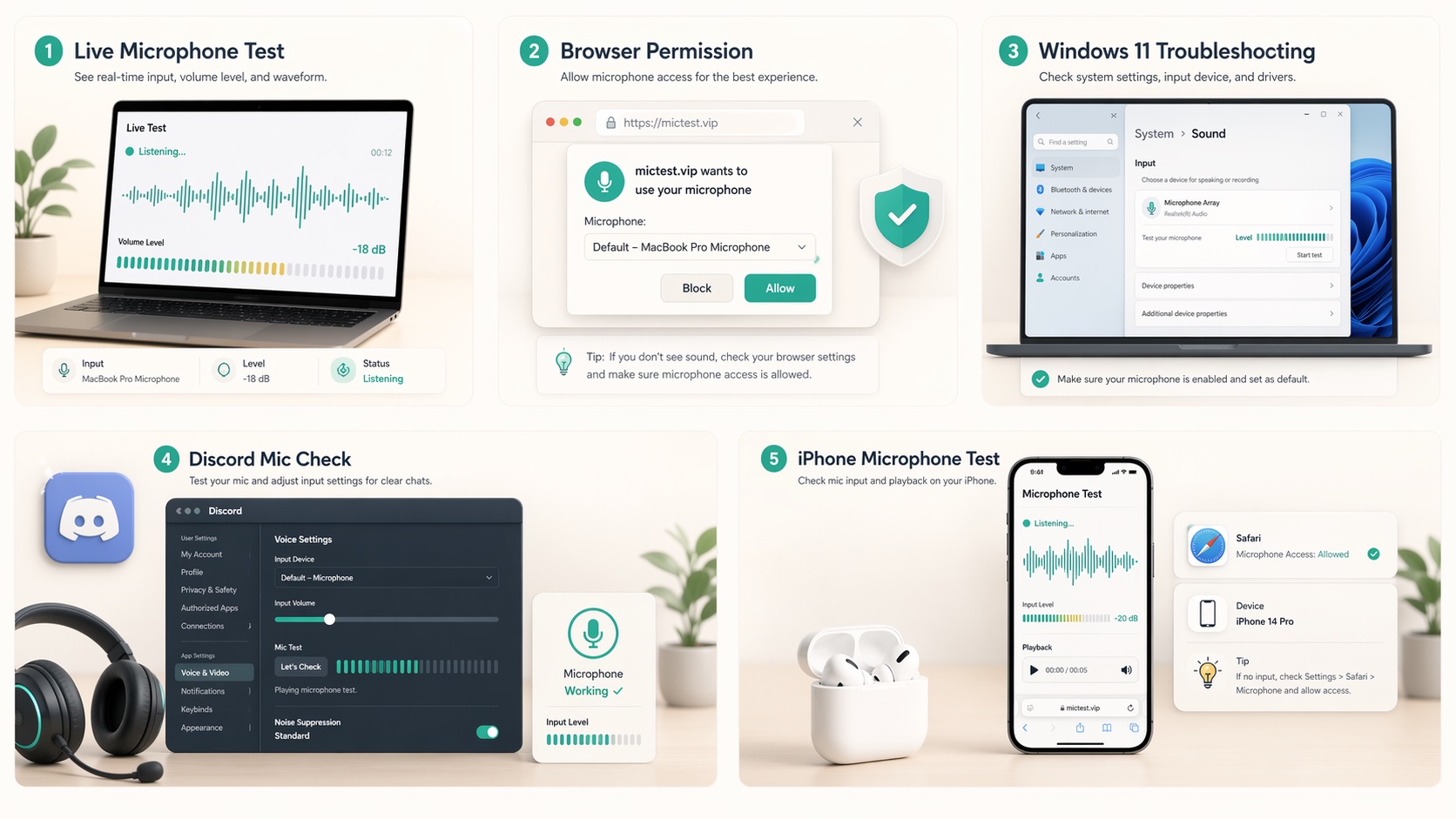
Related microphone guides
Windows 11 Mic Fix
Fix microphone not working on Windows 11 with a practical checklist for privacy settings, input selection, volume, headset jacks, USB mics, and drivers.
Discord Mic Test
Use a Discord mic test workflow to fix no input, wrong device selection, silent playback, and mic quality problems before you join voice chat.
iPhone Mic Test
Run an iPhone microphone test online in Safari or Chrome, check live input and playback, and fix common problems like blocked permissions, muffled sound, and Bluetooth routing.